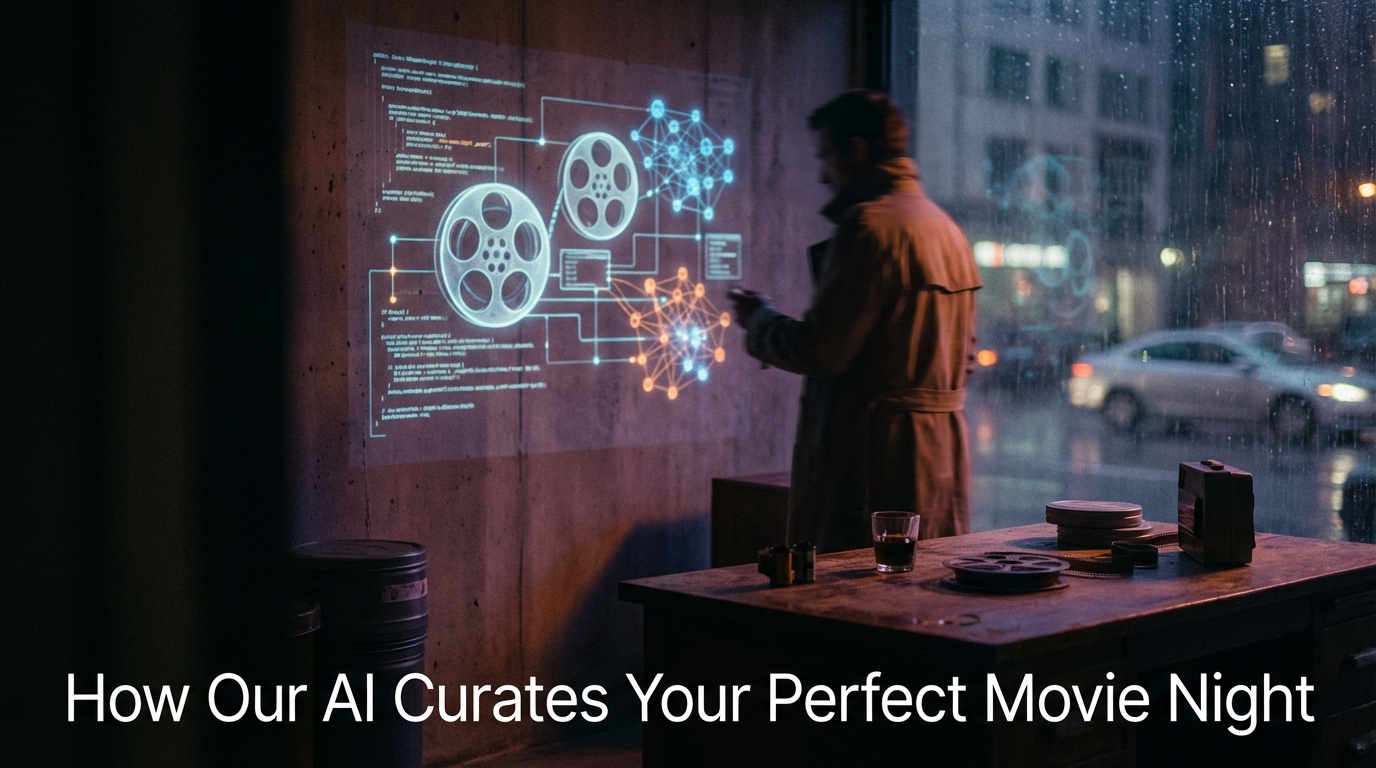
How Our AI Curates Your Perfect Movie Night
A behind-the-scenes look at how Gemini AI, vector embeddings, and semantic search power Filmsantrali's recommendations.
The Architecture of Taste
Filmsantrali is not a recommendation engine built on what other people watched. It is a taste mapping system built on how films actually feel.
Here is what happens when a new movie enters our system:
Step 1: Ingestion
Every day, our automated cron job fetches trending and top-rated films from TMDB. Each movie's plot synopsis is sent to Google Gemini 2.5 Flash for deep aesthetic analysis.
Step 2: Vibe Extraction
Gemini reads the synopsis and generates 3-5 hyper-specific vibe tags. These are not standard genres — they are atmospheric descriptors like Paranoia-Fueled Betrayal Spiral or Washed-Ashore Found Family.
Step 3: Embedding
The vibe analysis is converted into a 768-dimensional vector using Gemini's embedding model. This vector is a mathematical representation of the film's aesthetic DNA.
Step 4: Storage
The vector is stored in Supabase using pgvector, enabling lightning-fast cosine similarity searches across the entire catalog.
Step 5: Discovery
When you use AI Search, your natural language query is also converted into a 768-dim vector. We find the films whose vectors are closest to yours — films that feel like what you described, even if they share zero keywords.
The Result
A search for "a stressful heist movie set in the snow" does not rely on matching the words "heist" or "snow." It finds films whose aesthetic fingerprint aligns with the feeling of a cold, high-tension caper. That is the power of semantic search.
Try it yourself with the AI Search on our homepage.